The direct answer: Luma is the cultural successor to Eventbrite—a discovery platform designed to get people you’ve never met to show up to events. Eventually is brand infrastructure designed to bring people into your community, on your site, on your terms. They look like they’re solving the same problem. They’re not.
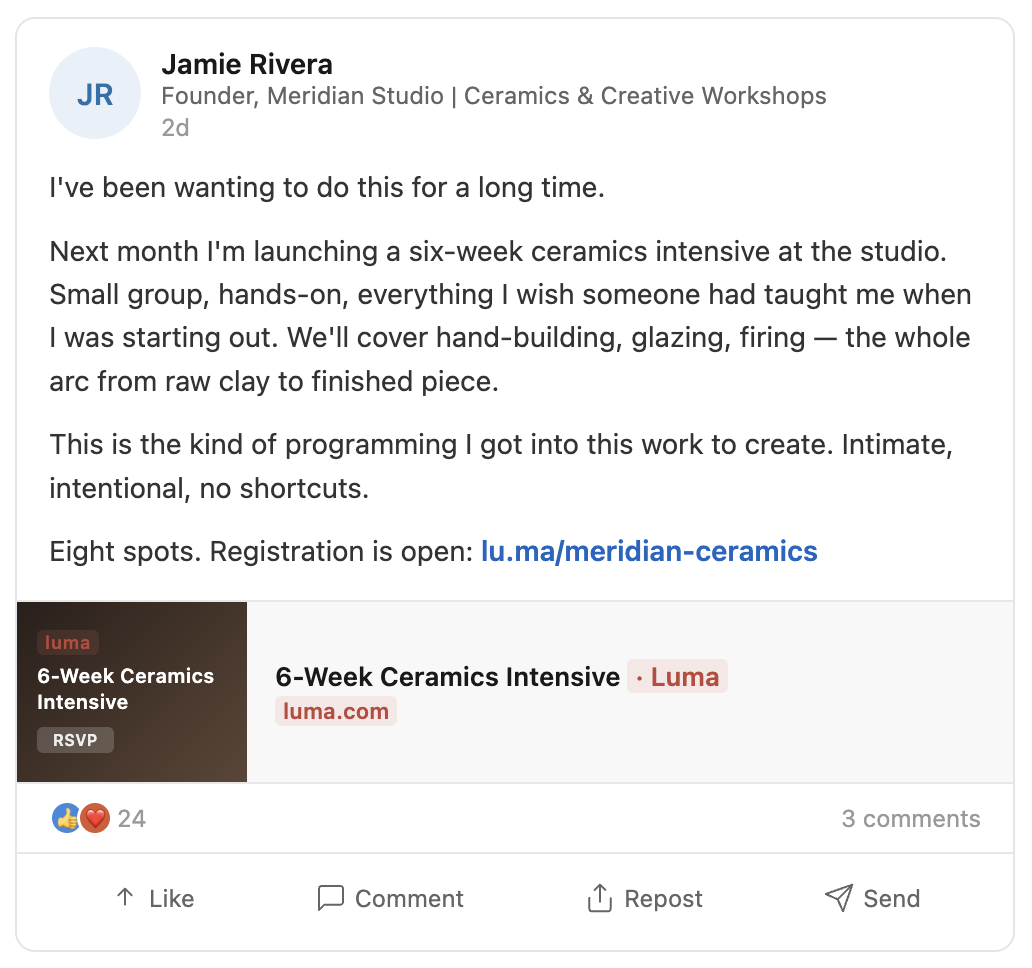
“I’ll just put up a Luma”
You’ve heard someone say it. Maybe you’ve said it yourself. “I’m doing this workshop next month—I’ll just put up a Luma.”
It’s become shorthand the way “I’ll make an Eventbrite” used to be. Quick, easy, no friction. And that’s exactly the problem—because that shorthand is doing something to your brand that you might not notice until it’s too late.
The moment someone clicks through to your Luma page, they’re on Luma’s site. Your event looks like every other event on Luma. Your brand, your design, your carefully built Squarespace site—none of it comes with you. The guest isn’t experiencing your world anymore. They’re experiencing Luma’s.
And look—Luma’s world is well-designed. That’s part of what makes it seductive. But it’s not your world. That distinction matters more than most people realize when they’re in a hurry to get a registration page up.
Two fundamentally different philosophies
This isn’t a features comparison. It’s a philosophy comparison.
Luma is built around discovery. Its core value proposition is the network effect—you post an event, Luma’s social graph surfaces it to people who might be interested, and strangers show up. That’s genuinely powerful if you’re throwing a one-off dinner party, a networking night, or a launch event where you want maximum reach beyond your existing audience.
Eventually is built around ownership. Its core value proposition is that your event lives on your Squarespace site, runs through your checkout, captures attendee data into your system, and looks like it belongs there—because it does. That’s the right architecture if you’re running a business where the event is part of an ongoing relationship with your community.
Neither philosophy is wrong. But they lead to very different outcomes over time.
With Luma, every event you host builds Luma’s brand recognition. Your guests remember registering on Luma. They get emails from Luma. They start checking Luma to see what’s happening. Over time, you’re building someone else’s audience while running your own events. That’s the exact trade Eventbrite offered for a decade—discovery in exchange for brand ownership. Luma just does it with better design and a social layer that Eventbrite never figured out.
With Eventually, every event you host builds your brand. Your guests register on your site. They get emails from you. They bookmark your calendar, not a platform’s. The tool disappears. Your community compounds. That’s a fundamentally different trajectory—and the difference gets more significant the longer you’re running programming.
What “just putting up a Luma” actually costs you
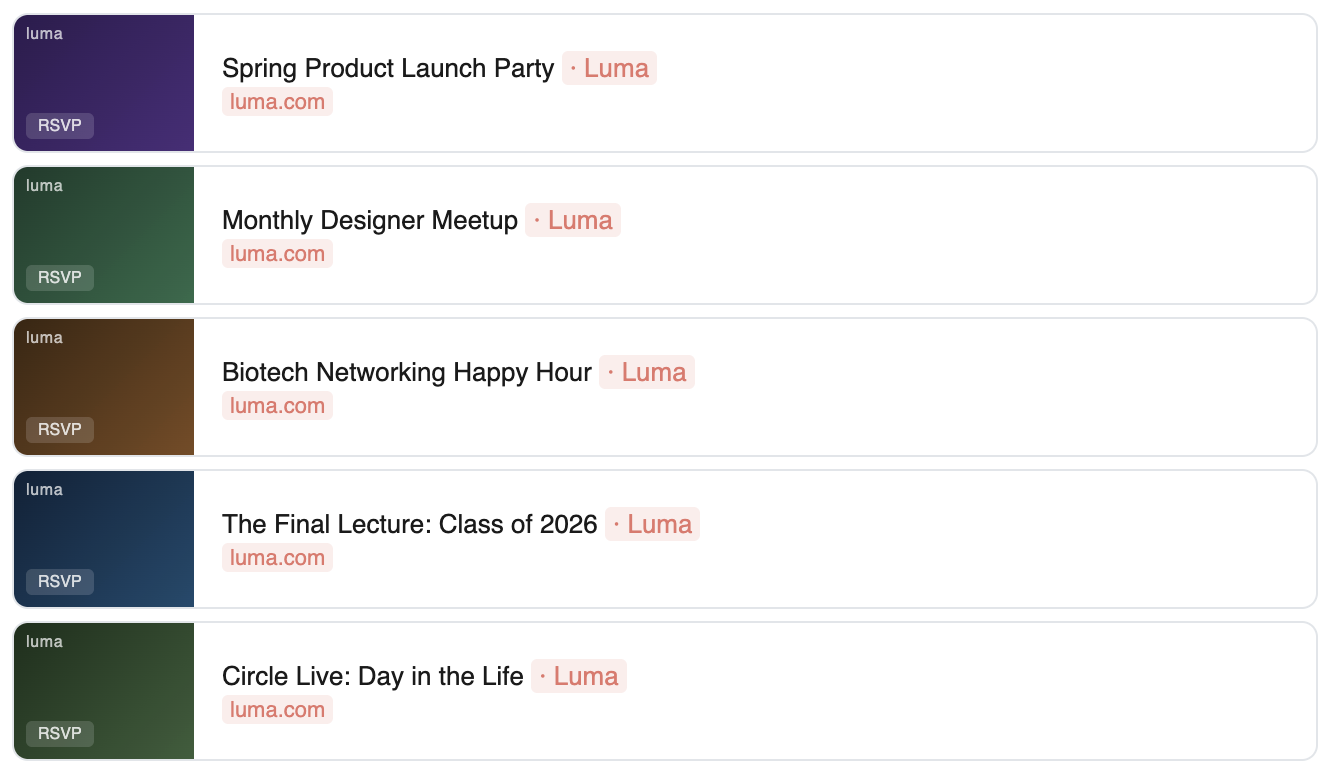
Brand dilution: Every time a guest registers through Luma, they’re building a mental association with Luma’s brand, not yours. Over months and years of recurring programming, that adds up. Your workshop series starts to feel like “a Luma thing” instead of “a you thing.”
Audience fragmentation: Your attendee data lives in Luma. Your commerce data lives in Squarespace. Your email list lives somewhere else. For a yoga studio running weekly classes, a ceramics teacher with monthly workshops, or a wine bar hosting tasting series—that fragmentation means you’re never seeing the full picture of who your people are and how they engage with you.
Checkout friction: If you’re already running Squarespace Commerce—selling products, gift cards, memberships—adding Luma means your guests now have two completely separate checkout experiences. One on your site, one on Luma’s. That’s redundant infrastructure and a fractured guest experience.
Recurring event pain: Luma treats each event occurrence as a separate page. If you run a weekly class, a monthly series, or a multi-session workshop, there’s no native way to register someone once for the whole series. Every session is a standalone event. For ongoing programming, that’s not a minor limitation—it’s a structural mismatch.
What Luma does brilliantly
This is an honest comparison, so let’s be honest: Luma is excellent at what it’s designed for.
The event pages are clean, minimal, and polished with almost zero effort. The social sharing is genuinely best-in-class—when someone shares a Luma link, it looks good in every context. The discovery engine works. If you’re hosting a one-off event and want people outside your existing network to find it, Luma’s social graph is a real advantage.
For community organizers, event promoters, and people building audiences from scratch, Luma is a strong choice. It’s free for free events. It’s fast to set up. It removes friction from the “get a page up quickly” problem in a way that few tools match.
And the social sharing—it’s worth calling out specifically. When someone shares a Luma event link on Twitter or LinkedIn or iMessage, the preview card is clean, informative, and compelling. It makes you want to click. That’s not an accident—Luma invested heavily in making their events look good when shared, and it works. It’s one of the things we’re studying closely as we build Eventually, because shareable event pages shouldn’t require handing your brand over to a platform.
The question isn’t whether Luma is good. It is. The question is whether a discovery platform is the right foundation for your ongoing business programming.
What brand-owned event infrastructure actually requires
Before talking about any specific tool, here’s what the ideal setup looks like for a Squarespace business running recurring events:
Events that live on your site, not on a third-party domain
Checkout through the same system your guests already use for your products
A single calendar showing all your programming—free, paid, recurring, one-off
Attendee data that feeds back into your own system, not someone else’s
Series and multi-session registration that doesn’t require guests to sign up for each occurrence separately
Automated confirmation and reminder emails that match your brand
Design that matches your Squarespace site—not a platform’s default template
If you’re nodding at that list, you’ve already identified the gap that Luma—like most event tools—leaves open.
Side-by-side comparison
When to use Luma
Use Luma when the event page is the product. When you’re hosting something once, want it to look polished immediately, and your growth strategy depends on reaching people outside your existing audience. When discovery through Luma’s network is genuinely valuable to you. When you’re testing a format before committing to a series.
Luma is a promoter. A very good one. If you need a promoter, use one. But know what you’re trading for that promotion.
When to use Eventually
Use Eventually when your Squarespace site is the hub. When you’re running workshops, series, or recurring programming that’s core to your business. When you want one calendar showing everything—free events, paid events, recurring classes—in one consolidated view on your own site. When the guest relationship belongs to you, not a platform.
Use it when you’ve already built something—a brand, a following, a community—and you want your events to feel like a natural extension of that work. When the people registering for your ceramics workshop are already on your site looking at your portfolio. When you don’t need a platform to find your audience because your audience already found you.
Eventually is infrastructure. It disappears into your site and lets your brand do the talking.
What we built and why
Eventually is a Squarespace-first extension built by Week of the Website—Squarespace’s only Enterprise Professional Services Partner, with over 1,000 sites launched since 2014. We built it because we spent a decade watching clients cobble together event workarounds, send their guests off-site to register, and fragment their brand across three or four different systems just to sell a workshop ticket.
Eventually creates events as Squarespace service products and sells tickets as service variants, which means checkout happens through Squarespace Commerce—the same system your guests already use for your other products. Attendee data syncs back to your dashboard. Confirmation and reminder emails go out automatically, in your brand. A calendar widget embeds on any page of your site. Recurring events, multi-session series, and multi-ticket-type events all work natively.
No external checkout. No brand fragmentation. No separate payment system. Your event feels like it belongs on your site because it does.
Flat monthly pricing. No per-ticket fees. A tool, not a tax.
What to do right now
If you’re currently using Luma for one-off events and it’s working: Keep using it. Luma is good at what it does. But if you’re starting to run recurring programming—weekly classes, monthly workshops, multi-session courses—evaluate whether a discovery platform is still the right foundation.
If you’re running recurring events on Luma and feeling the friction: That friction is structural, not situational. Luma wasn’t designed for ongoing programming. The separate-event-per-occurrence model doesn’t scale when you’re running 4–12 events a month.
If your attendees are already coming from your own channels: You don’t need a discovery platform. You need infrastructure. Calculate what you’re paying in per-ticket fees and compare it to a flat subscription. Then ask whether your guests should be registering on your site or someone else’s.
If you’re a designer recommending tools to a client: Ask one question—where do their attendees come from? If the answer is “our email list,” “our Instagram,” or “our existing community,” they don’t need Luma’s network. They need their brand to stay intact through the entire event experience.
If you want Luma’s social shareability but on your own terms: That’s exactly what we’re building toward. Beautiful, shareable event pages that live on your site and look like yours—not ours.
The bottom line
Luma is a better tool for one-off social events where discovery is the goal. Eventually is a better tool for structured programming on Squarespace where brand ownership is the goal.
“I’ll put up a Luma” is easy to say. But every time you say it, you’re making a choice about where your guests’ experience lives and whose brand they remember. For a dinner party, that choice doesn’t matter much. For a business built on gathering people—a studio, a school, a community space—it’s the whole game.
Eventually exists because we believe your events should feel like yours. Not like a platform. Not like a workaround. Like the natural extension of the site you already built. The best event infrastructure disappears—and what’s left is just your brand, doing what it does best: gathering people.
Keep reading: