The direct answer
Calendar-centric selling is any business model where the primary transaction happens around a date and time. A yoga class on Saturday morning. A wine tasting on Friday night. A cookie decorating workshop next month. A fundraiser gala in November. A conference in October. A weekly trivia night.
If your business makes money by gathering people in a time and place — charging them or not — you're a calendar-centric seller. And there are a lot more of you than there used to be.
Why this needs a name
Shopify built a $75 billion company around selling products. Calendly and Acuity handle appointment booking. Eventbrite and Ticketmaster sell tickets to big events. Those categories are well-served.
But there's a whole middle ground that doesn't fit any of those. Businesses that aren't selling products — they're selling time together. Not booking one-on-one appointments — they're hosting groups. Not producing stadium concerts — they're running a Saturday morning ceramics class for 12 people.
Nobody built tools specifically for them. So they adapted. They used Eventbrite and accepted that guests would leave their website. They used Squarespace Scheduling and pretended one-to-many events were appointments. They built Zapier automations and hoped they wouldn't break the week of their biggest event. They created individual service products by hand, 52 weeks in a row.
And gradually, many of them stopped thinking about it. They didn't decide events weren't worth running. They just absorbed the friction into their daily operations until it became invisible.
The appointment booking parallel
Fifteen years ago, nobody thought about monetizing appointment booking. You'd call someone's office. A receptionist would write your name on a slip of paper and put it in a box. Appointment confirmed.
Then Calendly, Acuity, Square Appointments, and dozens of others came along. They didn't just make scheduling easier — they created entirely new categories of business. Therapists started taking clients online. Consultants stopped losing leads to phone tag. Salons let customers book at 11pm. The tools didn't just serve existing demand. They created new demand by removing friction.
Calendar-centric selling is heading the same direction. When the tools to sell event tickets, manage attendees, and follow up with registrants get easy enough — and cheap enough, and native enough to your own site — more people will do it. Including people who haven't started yet.
What calendar-centric selling looks like in 2026
Five years ago, if you said you were going to start a rug tufting business where people could come and tuft rugs in your neighborhood, people would look at you like your face had turned green.
In 2026, there are three rug tufting studios in my neighborhood alone. There are places where you can spill paint on stuffed bears. You can pay $150 to shoot water guns full of paint at a wall. There are cookie decorating classes, ceramics studios, candle-making workshops, breath-work sessions, foraging walks, and sourdough starters with waiting lists.
And it keeps going. The more of daily life moves onto screens, the more people want to do things in rooms with other people. The things they're willing to pay for in person keep getting more specific and more frequent. Five years ago there was no market for guided foraging walks. Now there are waiting lists.
Every one of those businesses is a calendar-centric seller. Their revenue depends on getting people to show up somewhere at a specific time. And the tools they use to sell those spots — or don't use, because the tools are bad — directly shape how many events they bother running.
The producer vs. the promoter
There's a split in the event world that most ticketing platforms ignore.
A promoter needs discovery. They're putting on a show and they need people to find it. Eventbrite's marketplace, Instagram ads, cross-promotion with other events — the promoter's job is to fill a room with people who didn't know about the event yesterday.
A producer already has their audience. They're a cake decorating studio and their students find them through Instagram, email, and word of mouth. They're a vineyard and their guests are regulars who check the website calendar every weekend. They're a nonprofit and their attendees come from the community they've been building for years.
Producers don't need a ticketing platform's marketplace. They need a ticketing system that works on their website. Their guests don't browse Eventbrite looking for things to do — they go directly to the business's site because they already know and trust the brand.
When a producer uses a promoter's tool, they're paying for distribution they don't use and sending guests off the site they spent years building. The money part is annoying. The brand part is worse.
Calendar-centric selling tools should work for producers. The checkout stays on their site. The emails match their brand. The calendar lives where their guests already look. The pricing is flat, because why would a producer pay per ticket for discovery they're providing themselves?
What this means for your business
If you recognize your business in any of the examples above, a few things are probably true:
Your calendar is your storefront
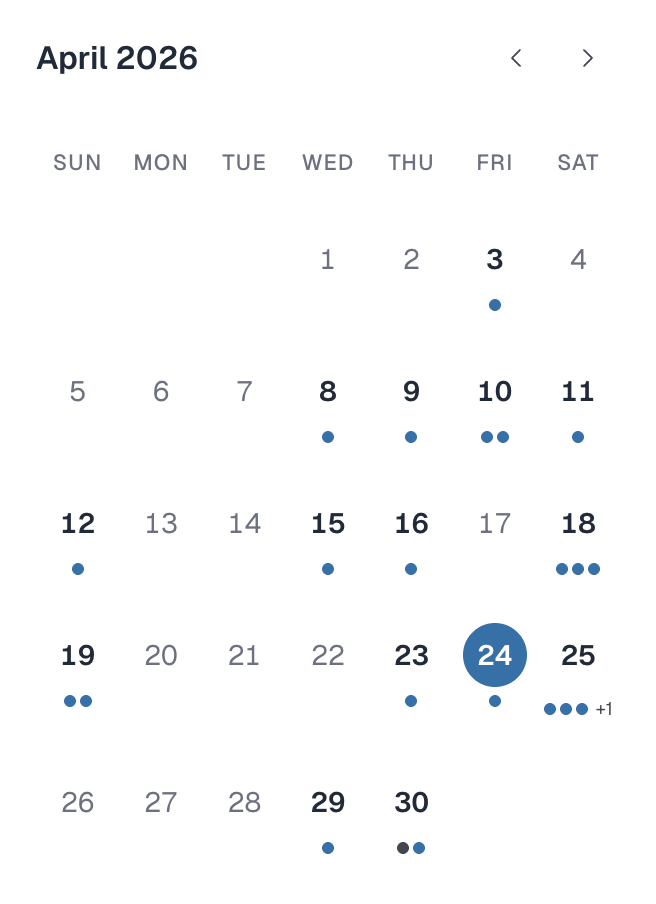
For product businesses, the homepage is the storefront. For calendar-centric sellers, the event calendar is. It's where people decide whether your business feels alive, whether there's something worth showing up for, and whether they want to be part of it. A calendar full of vivid, well-described events with real images creates FOMO. A calendar full of identical entries that say “Weekly Class” 52 times creates nothing.
You're losing 80% of your attendee data
When someone buys four tickets to your workshop, you get one email address — the purchaser's. The other three people in the room? You have no idea who they are. You can't send them prep emails, follow-up offers, or invitations to future events. A good event tool captures every attendee, not just every buyer.
Demand intelligence: the skill most event sellers don't know they have
One of our first customers described her workflow: she watches ticket sales in real time, and when two classes underperform, she cancels them, slots in a proven seller, sends one email, and fills those seats by end of day. That's not just selling tickets. That's reading demand signals and making fast decisions. The tools you use to manage your calendar should make that kind of agility possible, not harder.
Flat pricing changes the math
Per-ticket fees turn every attendee into a cost. A yoga studio running two classes a week at 15 people each pays roughly $2,000 a year in Eventbrite fees. A vineyard running 130 events a year pays over $13,000. That's not the cost of running events — that's the cost of using the wrong tool. Calendar-centric selling tools should be priced like tools: a flat monthly subscription that doesn't punish you for selling more.
The bet we're making
At Eventually, our core thesis is simple: people would actually be doing this more if it was easier.
Not just existing businesses running more events. New businesses that don't exist yet. The rug tufting studio that hasn't opened. The neighborhood dinner series that's still just an idea. The nonprofit that would run monthly programming if they had a real registration system instead of a Google Form.
Calendly didn't just give existing businesses better scheduling. It made a generation of businesses possible that couldn't have existed without it. We think calendar-centric selling is going to be bigger than people expect — for the same reasons.
Eventually is the tool that makes it happen. Not a marketplace. Not a promoter. A tool that works on your website, captures every attendee, sends emails in your voice, and charges a flat monthly subscription regardless of how many tickets you sell.
The businesses we're building this for don't need more discovery. They need better tools. And they need those tools to feel like they belong on the site they've already built.
Keep reading:
→ How to Sell Event Tickets on Squarespace
→ The Real Cost of Eventbrite Fees for Small Events
→ Squarespace Event Ticketing: Every Option Compared